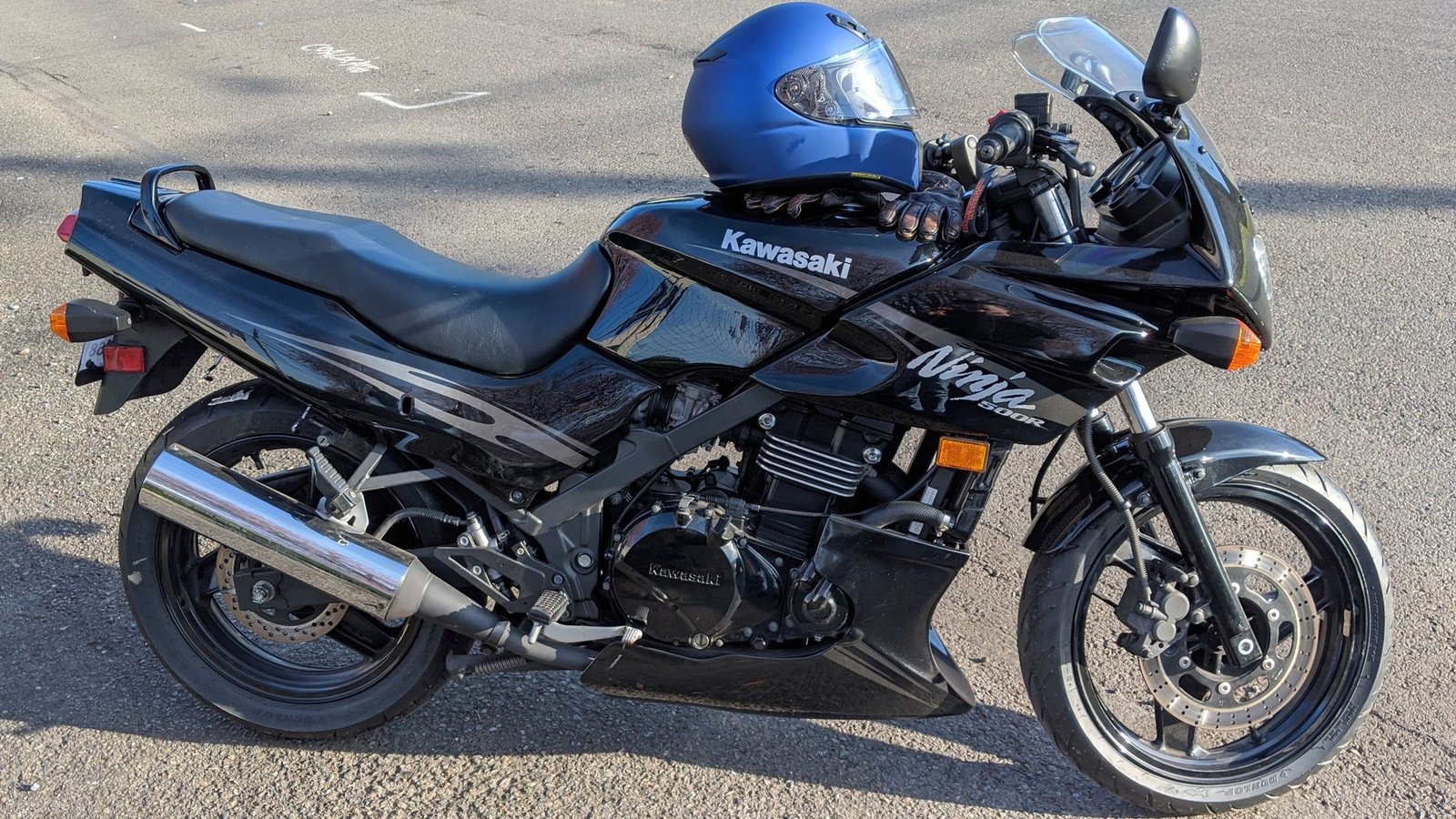
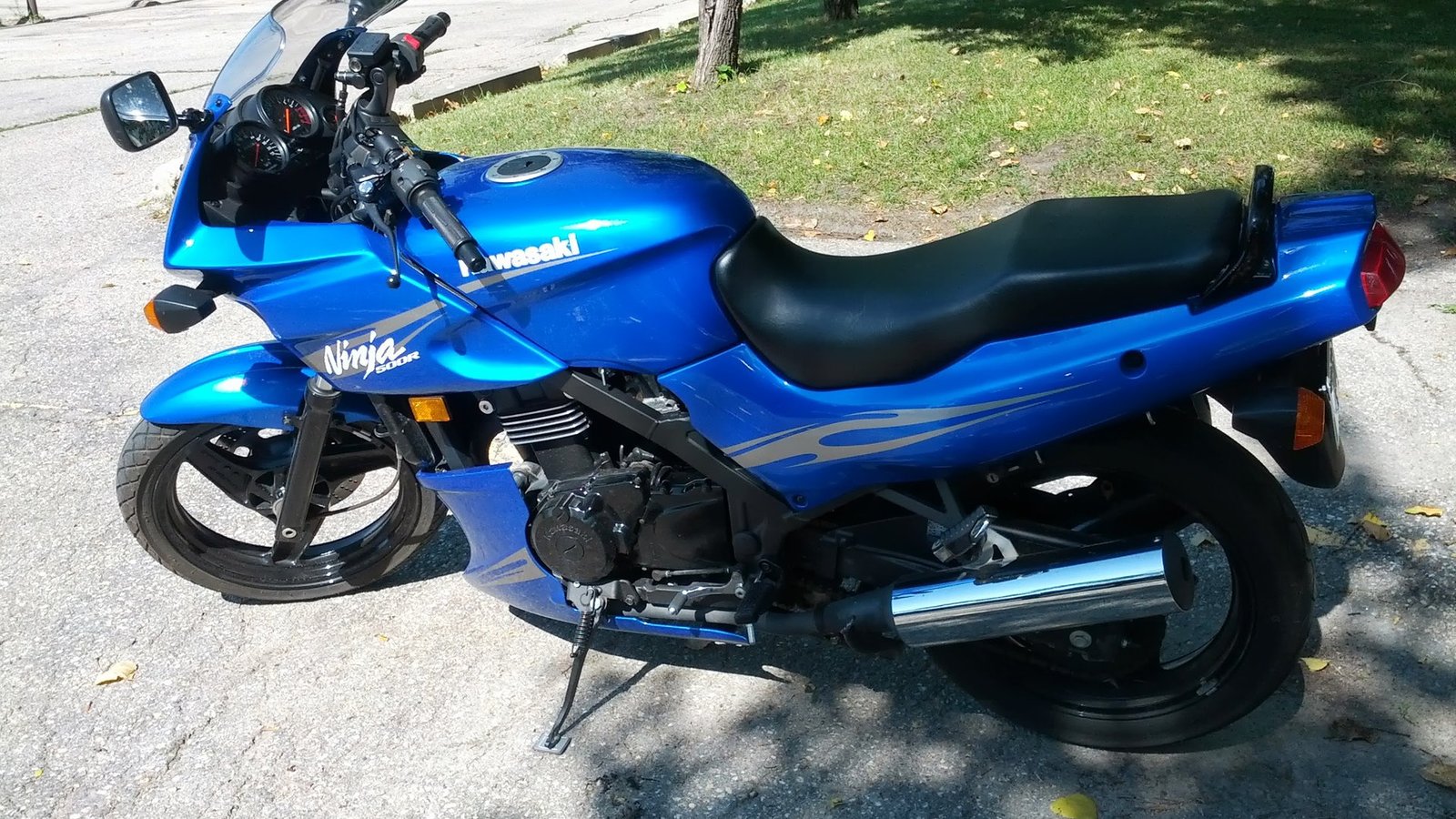
The Kawasaki Ninja 500 is a sport motorcycle built around a 451cc liquid-cooled parallel twin. It fits best as a first bike for a new rider or as a practical commuter that can also handle twisty roads. Kawasaki says it is crafted with ample control for newer riders while offering extra punch to appeal to a wide range of riders.
Kawasaki Ninja 500 Overview
Kawasaki says the Ninja 500 handles from canyon roads to daily commutes and is built to inspire confidence. It replaces the 400 models in the US lineup, so if you are comparing it with older 400-series bikes, that is the direct successor.
Kawasaki also describes the Ninja 500R as a favorite first motorcycle for new riders and popular with experienced riders on a budget. That description is for the 500R, so treat it as context for the family rather than a direct claim about this model.
Engine & Performance
The engine is a 451cc twin-cylinder, four-stroke, liquid-cooled parallel twin. Kawasaki describes it as an increase over the previous 400-series engine, and the stroke is longer than the Ninja 400’s. The bore and stroke are 70.0 x 58.6 mm.
| Specification | Figure |
|---|---|
| Displacement | 451cc twin-cylinder |
| Bore and stroke | 70.0 x 58.6 mm |
| Claimed peak power | 51.0 hp at 10,000 rpm |
| Claimed peak torque | 31.7 lb-ft at 7,500 rpm |
| Alternate listing | 51 bhp and 43 Nm |
Kawasaki claims 51 hp at 10,000 rpm and 31.7 ft-lb of torque at 7500 rpm. Another listing puts the torque peak at 8000 RPM. If the exact torque peak matters to you, check the spec sheet you are reading.
Cycle News found the power smooth and predictable, with a slight boost over the Ninja 400. The same publication says the bike excels on canyon roads with its agility and delivers stable, predictable performance. For a new rider, that kind of predictable delivery is the point, not outright speed.
Chassis & Ergonomics
The chassis uses a 41mm non-adjustable hydraulic telescopic fork at the front. Kawasaki’s spec sheet lists the fork as a Showa unit, and it has no adjustable preload or rebound damping. Travel is 4.7 inches.
At the rear, the spec pages describe a horizontal back-link shock with adjustable spring preload and 5.1 inches of travel. Other listings use the UNI-TRAK name and a twin-sided swing arm. Those are different descriptions of the same rear end, so expect some variation between sources.
| Component | Detail |
|---|---|
| Front fork | 41mm telescopic, 4.7 in travel |
| Rear shock | Adjustable spring preload, 5.1 in travel |
| Front brake | Single 310 mm disc, two-piston caliper |
| Rear brake | Single 220 mm disc, single-piston caliper |
| Fuel capacity | 3.7 gallons |
The front brake is a single 310 mm semi-floating disc with two-piston calipers. The rear uses a single 220 mm disc with a single-piston caliper. On ABS-equipped versions, those brakes work with the ABS system.
ERGO-FIT lets you adjust chassis points through interchangeable and adjustable parts to find your ideal riding position. How much you can adjust varies by model. Kawasaki says ERGO-FIT lets a wide range of riders find a position that offers comfort and control.
Seat Height and Clearance
Kawasaki lists the seat height at 30.9 inches. The SE ABS model is listed at the same height. Ground clearance is 5.7 in (144.8 mm), which is the only ride-height figure on that page.
Weight
Curb weight includes all necessary materials and fluids, a full tank of fuel, and a tool kit if supplied. Kawasaki’s claimed curb weights run from 370.4 lb for the non-ABS base to 381.5 lb for the SE 50-State model. Dry weight leaves out the necessary fluids, fuel, and tool kit.
| Measure | Figure |
|---|---|
| Curb, non-ABS base | 370.4 lb |
| Curb, 50-State | 381.5 lb |
| Curb, 49-State | 379.3 lb |
| Wet curb (Cycle News) | 379 lbs |
| Dry, 50-State | 350.6 lb |
| Dry, 49-State | 348.4 lb |
| Dry, metric listing | 350.6 lbs (159 kg) |
Features
The non-SE models use a full LCD panel with a digital bar tachometer, fuel gauge, consumption readouts, and a service indicator. The SE models use a TFT display instead. The SE adds LED turn signals, a 2.5-inch taller windscreen, a radiator screen, frame sliders, a seat cowl, tank and knee pads, and a USB charger.
| Feature | Non-SE | SE models |
|---|---|---|
| Instrument display | High-contrast full-LCD meter | High-grade full-color TFT |
| Key | Standard | Remote key fob |
| Power outlet | Not listed | USB-C outlet |
| Turn signals | Not listed | LED rear turn signals |
| Windscreen | Standard | Larger windshield |
| Protection | Standard | Radiator screen, pillion cover, tank pad, knee pads |
The SE ABS adds a TFT display, a remote key fob, a USB-C outlet, and LED rear turn signals. The KRT SE ABS adds KIPASS key fob ignition, frame protectors, and a USB charging port. The Z500 SE adds frame sliders and LED turn signals to a similar list.
Connectivity is handled through RIDEOLOGY THE APP. The app lets you view vehicle information and riding logs, and it sends call and mail notices. The bike also has a hazard button and app support for GPS ride tracking and maintenance logging.
ABS
ABS is available on the Ninja 500. On the Ninja 500 it is optional, while on the Z500 it is standard. The 2026 SE ABS model includes ABS.
Kawasaki’s ABS uses front and rear wheel sensors to monitor wheel speed and modulate brake fluid pressure when it detects wheel lock. If you plan to ride in the rain or on unfamiliar roads, that system is worth having.
Price & Trims
The MSRP for the Ninja 500 range runs from $5,299 to $6,599. The base price matches the outgoing Ninja 400, and the 2023 Ninja 400 also starts at $5,299.
| Trim | MSRP (USD) |
|---|---|
| Non-ABS base | $5,299 |
| KRT Edition | $5,499 |
| SE KRT Edition ABS | $6,399; 2024 Ninja 500 KRT Edition SE ABS |
| SE ABS | $6,499 |
| SE 40th Anniversary Edition ABS | $6,599 |
If you want the SE ABS equipment, the SE KRT Edition ABS lists at $6,399, below the SE ABS at $6,499. The KRT Edition itself lists at $5,499. Compare the included equipment in each trim before deciding on price.
Who It’s For
The reviewer describes the Ninja 500 as a good choice for new riders who want a motorcycle they can learn on and love riding. The same reviewer says it suits canyon riding, spirited riding, and commuting. Cycle News calls it an excellent option for new riders looking to learn and for those new to street riding.
If you commute, the mix of agility and steady power is the main draw. Its ERGO-FIT adjustments can help you set a comfortable position for longer days in traffic. Kawasaki also lists a 12-month limited warranty, which is worth knowing when you compare it with other new bikes.
If you already ride and want a different Kawasaki, the Kawasaki Z650: Middleweight Naked Bike Profile and Kawasaki Announces the Return of the Ninja ZX-6R for 2027 cover other models.
FAQ
Is the Kawasaki Ninja 500 a good first motorcycle?
Yes, for most new riders it is a sensible choice. Kawasaki says it offers ample control for newer riders, and Cycle News calls it an excellent option for new riders.
Does the Kawasaki Ninja 500 come with ABS, and does it cost extra?
ABS is available, and it is optional rather than standard on the Ninja 500. The non-ABS base lists at $5,299, while the SE ABS lists at $6,499. That gap also includes the SE equipment, so ABS is not the only difference.
How much does the Kawasaki Ninja 500 weigh, and what is its seat height?
Kawasaki’s claimed curb weights run from 370.4 lb for the non-ABS base to 381.5 lb for the SE 50-State model. The seat height is 30.9 inches.
How much does the Kawasaki Ninja 500 cost, and what trims are available?
MSRP ranges from $5,299 to $6,599. Trims include the non-ABS base, KRT Edition, SE ABS, SE KRT Edition ABS, and SE 40th Anniversary Edition ABS, listed in the table above.
Bottom Line
The Kawasaki Ninja 500 is a 451cc parallel twin with a clear focus on new riders and daily use. Reviewers describe it as a good first bike, and it starts at $5,299 with ABS-equipped trims reaching $6,599. Check the trim, ABS, and weight numbers against the exact model you are considering.
Sources
- 2026 Kawasaki Ninja® 500 | Sport Motorcycle | Legendary Performance
- Kawasaki Ninja® 500 | Motorcycle | Approachable Power
- 2026 Kawasaki Ninja® 500 SE ABS | Sport Motorcycle | Legendary
- Kawasaki Ninja 500R – Wikipedia
- 2026 Kawasaki Ninja® 500 SE ABS | Sport Motorcycle | Legendary
- 2024 Kawasaki Ninja 500, Z500 Announced for USA
- 2024 Kawasaki Ninja® 500 ABS
- 2024 Kawasaki Ninja 500 Review – First Ride
- 2024 Kawasaki Ninja 500 Review
- 2026 Kawasaki Ninja® 500 SE ABS
- 2024 Kawasaki Ninja® 500 SE ABS
What do you feel about this post?

Like

Love

Happy

Haha

Sad