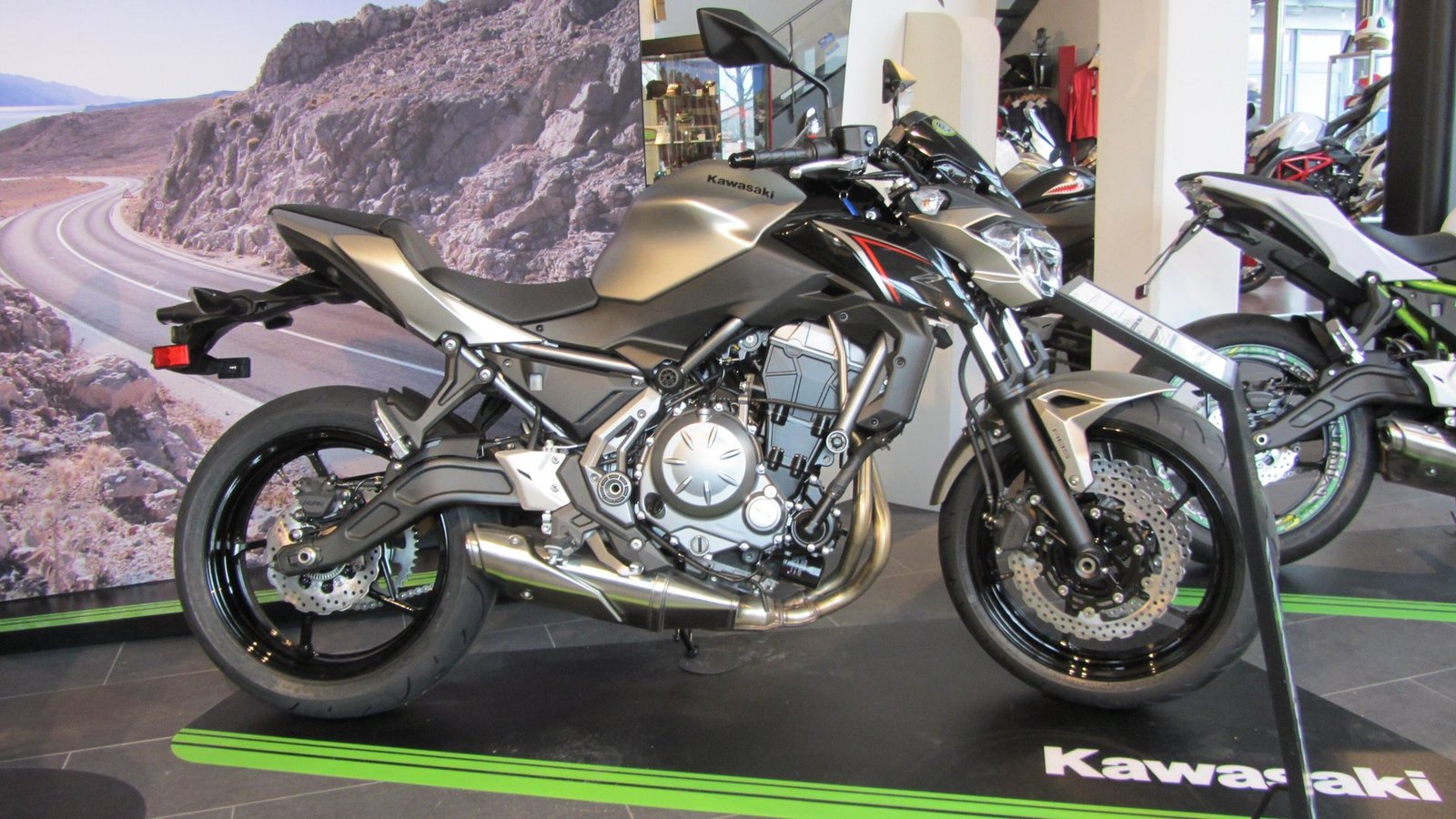
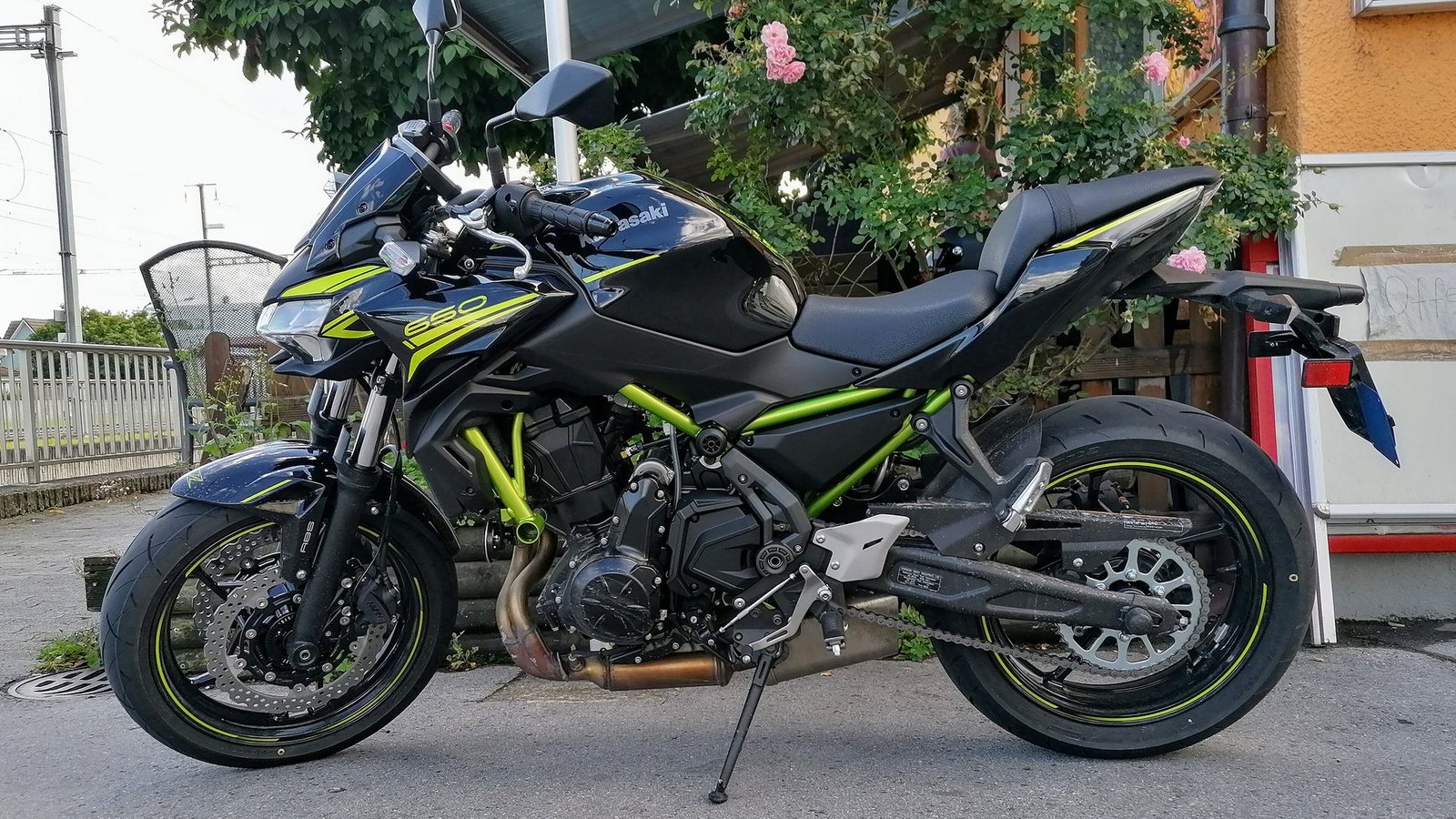
The Kawasaki Z650 is a middleweight supernaked motorcycle — a 649 cc (39.6 ci) parallel-twin roadster with aggressive Sugomi styling, positioned as the practical, everyday counterpart to the Ninja 650. Kawasaki introduced it in 2017 as part of the brand’s new Z series of naked bikes. It is aimed at new riders, downsizers, and city dwellers who want something unintimidating and manageable. Here is how the bike is built, what it costs, and who it fits.
Overview: What Is the Kawasaki Z650?
Kawasaki classes the Z650 as a middleweight supernaked with aggressive, bold Sugomi styling. The bike first appeared in the 2017 model lineup as part of Kawasaki’s new Z series of naked bikes, and it arrived as the replacement for the ER6-n, bringing a new swingarm and a horizontal back-link shock in place of the ER6’s side-mounted unit. Compared with the Ninja 650, Kawasaki positions the Z650 as slightly less sporty and more practical, with an everyday profile.
Kawasaki pitches the Z650 to riders who refuse to compromise, promising a balance between sporty performance and all-day ride comfort. In a class full of sharp-edged roadsters, that everyday focus is what sets this bike apart. The sections below break down the engine, chassis, features, and pricing so you can judge that balance for yourself.
Engine & Performance
Power comes from a 649 cc (39.6 ci) parallel twin — a four-stroke, two-cylinder engine with DOHC and 8 valves total, 4 per cylinder. The engine is liquid-cooled and fuel injected. Kawasaki says it puts out 67.3 bhp, with peak power arriving at 8000 rpm and peak torque at 6500 rpm. It is the same motor found in the Ninja 650.
Kawasaki describes the engine as strong and torquey. Power routes through a 6-speed manual transmission and a chain final drive, with an Assist & Slipper Clutch that employs an assist cam and a slipper cam. On fuel economy, Kawasaki’s stated figure is 68.9 mpg, while a published test ride returned 52 mpg.
Character is where rivals differ. The Yamaha MT-07’s parallel twin and the Suzuki SV650’s V-twin are more engaging than the Z650’s engine, and the SV650 also handles better. The Z650’s counter is a friendlier, more manageable character. For a new rider, that manageable character matters more than a few extra horsepower.
Chassis & Ergonomics
The Z650 uses a trellis frame made of high-tensile steel, with an aluminum swingarm. The new trellis-style, high-tensile steel tubular frame and swingarm dropped a bunch of weight compared with the previous-generation Ninja 650. Kawasaki also credits the lightweight trellis frame with the Z650’s nimble handling.
Suspension is deliberately simple: a 41mm telescopic front fork with 4.9 inches of wheel travel, and a horizontal back-link rear shock with adjustable preload and 5.1 inches of wheel travel. Kawasaki describes that telescopic-fork-and-back-link combination as a balanced suspension package. Beyond the rear preload adjustment, there is no other adjustability — a choice made to keep costs down.
The table below collects the key chassis and dimension figures for the 2026 Z650 S ABS.
| Item | Spec |
|---|---|
| Seat height | 31.7 in |
| Frame | Trellis, high-tensile steel |
| Swingarm | Aluminum |
| Front suspension | 41mm telescopic fork, 4.9 in of wheel travel |
| Rear suspension | Horizontal back-link shock, adjustable preload, 5.1 in of wheel travel |
The riding position has been updated for added comfort and maneuverability, with new wider and roomier ergonomics. Kawasaki says the rider triangle places you in the bike rather than on top of it, for a feeling of confident, connected handling. Reviews describe the ergonomics as neutral but sporty, with bars that sit at a friendly height and sweep gently back to meet the rider. The small, narrow shape makes the bike comfortable for smaller riders, though tall riders are likely to find it cramped.
Features
The Z650’s feature set is straightforward, with a few accessory add-ons for tech-minded riders.
Instrumentation and Connectivity
The dash is a 4.3-inch all-digital TFT color instrumentation display. It pairs with RIDEOLOGY THE APP MOTORCYCLE for smartphone connectivity, and Kawasaki says the app adds available voice command and navigation functions. A front cowl-mounted USB Type-C outlet is available as an accessory. A Kawasaki Quick Shifter (KQS) is also available as an accessory.
Brakes and Rider Aids
Stopping power comes from dual 300mm semi-floating front discs with two-piston calipers, plus a single 220mm rear disc. An Anti-lock Brake System (ABS) is standard on the Z650 S ABS. Three-level KTRC traction control was added for the 2023 model year. The bike also runs full LED lighting for the turn signals and brake light.
Styling
Visually, the Z650 wears new muscular Sugomi styling that strengthens the Z family image. The aggressive look is half the bike’s identity; the approachable manners are the other half.
Price & Trims
In the US, Kawasaki has sold the bike as the Z650 ABS, and the current US-market Z650 S is an ABS-equipped supernaked marketed as the Z650 S ABS.
| Trim | US MSRP | Destination charge |
|---|---|---|
| 2023 Kawasaki Z650 ABS | $8,249 | $435 |
| 2024 Kawasaki Z650 (non-ABS) | $8,149 | — |
For the 2026 Z650 S ABS, Kawasaki lists a curb weight of 416.7 lb, or 419.0 lb for the 50-State Model, and an estimated dry weight of 374.9 lb, or 377.1 lb for the 50-State Model. Fuel capacity is 4.0 gallons. For the newest model year’s pricing, check Kawasaki’s website before you buy.
Who the Z650 Is For (and Who Should Look Elsewhere)
Kawasaki aims the Z650 at new riders, downsizers, and city dwellers, and reviews describe it as unintimidating, manageable, and easy to get to grips with. The everyday, practical profile is the whole idea — this is the less sporty, more sensible alternative to the Ninja 650 in Kawasaki’s own lineup. It also handles canyon roads and urban pavement well with a variety of riders aboard.
Fit matters, though. The Z650 feels physically smaller than middleweight rivals from Yamaha, Suzuki, and Honda — closer in size to a KTM 390 Duke — and among Japanese nakeds, only the SV650 has a lower seat. That small, narrow shape suits smaller riders best, while tall riders are likely to find it cramped.
If you want more engine character, the Yamaha MT-07 and the Suzuki SV650 are the more engaging picks. If you want more outright sport from Kawasaki, the Ninja 650 is the sportier sibling. And if you are shopping the sportier end of Kawasaki’s lineup, our story Kawasaki Announces the Return of the Ninja ZX-6R for 2027 has you covered.
FAQ
How much power does the Kawasaki Z650 make?
The 649 cc parallel twin makes 67.3 bhp. Peak power arrives at 8000 rpm, and peak torque at 6500 rpm.
Is the Kawasaki Z650 a good beginner bike?
It is aimed squarely at that audience: Kawasaki targets new riders, downsizers, and city dwellers, and reviews call the bike unintimidating and manageable. ABS is standard on the Z650 S ABS, and the 2026 S ABS carries a 416.7 lb curb weight.
How tall is the Z650’s seat, and is it good for short riders?
Seat height on the 2026 Z650 S ABS is 31.7 inches. The bike is small and narrow and accommodating for even the smallest riders, and among Japanese nakeds only the SV650 has a lower seat.
Does the Kawasaki Z650 have traction control?
Yes — the Z650 gained three-level KTRC traction control for the 2023 model year.
How much does a Kawasaki Z650 cost?
The 2023 Z650 ABS listed at $8,249, plus a $435 destination charge, and the 2024 non-ABS version listed at $8,149. For current pricing, check Kawasaki’s website.
Bottom Line
The Kawasaki Z650 is a middleweight supernaked built around a 649 cc parallel twin, pitched as the practical, everyday alternative to the Ninja 650. Kawasaki says it delivers a balance between sporty performance and all-day ride comfort for riders who refuse to compromise, and it is aimed at new riders, downsizers, and city dwellers. If unintimidating and manageable sounds like your kind of middleweight, the Z650 earns a spot on your test-ride list.
Sources
- 2026 Kawasaki Z650 S ABS | Supernaked | Style & Muscle
- Kawasaki Z650 S ABS | Naked Motorcycle | Sugomi™ Muscle
- 2023 Kawasaki Z650 ABS
- 2024 Kawasaki Z650/ABS
- First ride: Kawasaki Z650 review
- Kawasaki Z650 – Wikipedia
What do you feel about this post?

Like

Love

Happy

Haha

Sad